Integrating fireplaces in airtight homes: technical points of attention for architects
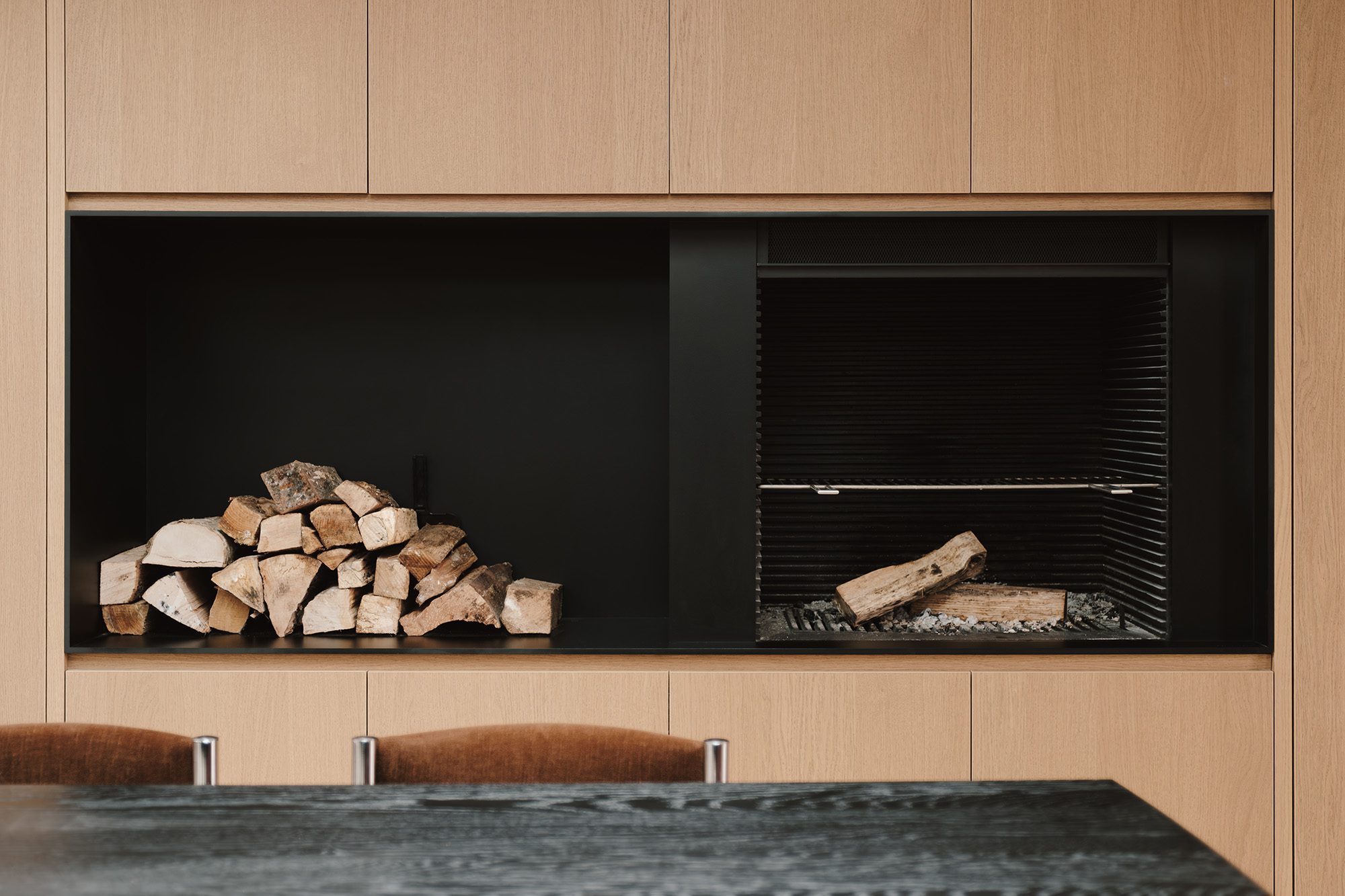
Contemporary architecture is airtight, highly insulated and ventilation-driven. In an energy-efficient home or nearly zero-energy home, the focus is on controlled air flows, minimal losses and maximum energy performance.
Classic fireplace systems do not fit into that naturally. Yet the demand for architectural fire remains, and fortunately that is perfectly possible. Built-in gas fires, built-in wood burning fireplaces and bespoke open wood and gas fireplaces can all be integrated into an airtight home, provided the technical integration is correctly planned from the design phase.
For architects that means: insight into negative pressure, type D balanced ventilation, flue gas outlet and controlled combustion. When technology and design are considered together, there is no conflict between energy performance and experience, but a reinforcement of both.
In brief
- Built-in gas fires, built-in wood burning fireplaces and bespoke open wood and gas fireplaces can all be integrated into an airtight or nearly zero-energy home.
- A correctly designed fireplace has its own air supply and its own flue gas outlet, forming an independent circuit that is separate from the balanced ventilation.
- Closed built-in fireplaces work room-sealed: gas fires via a concentric system, wood burning fireplaces via an external air supply with an insulated flue.
- Open fireplaces are perfectly feasible with a flue gas fan, an electric flue damper and an air damper that stay closed when the fireplace is not burning.
- Since 2003 Metalfire has designed and produced in its own workshop in Belgium, as one of the few manufacturers with full in-house production and engineering.
Why traditional open fireplaces require technical coordination in airtight homes
A traditional open fireplace works with open combustion and natural draught. The system draws oxygen directly from the room and discharges flue gases through the chimney. In an airtight home that requires extra coordination.
When a type D balanced ventilation system is active, negative pressure sometimes arises. Mechanical extraction, extractor hoods or other extraction systems reinforce that effect. Without additional technical provisions, the natural draught in the flue can be disrupted.
There is also the efficiency aspect. A traditional open fireplace has a lower efficiency and loses part of the heat through the chimney. In an energy-efficient home that weighs on the overall energy performance.
The conclusion is therefore not that an open fireplace is impossible. Rather, that open combustion and controlled ventilation only go together when air supply and flue gas outlet are technically worked out. With a flue gas fan, an electric flue damper and an air damper, an open fireplace is perfectly feasible even in a nearly zero-energy home.
Closed and room-sealed fireplaces as an efficient base solution
For those looking for maximum simplicity in combination with balanced ventilation, modern closed fireplaces are the most obvious choice. Both built-in gas fires and built-in wood burning fireplaces can work room-sealed.
A closed wood burning fireplace with external air supply draws combustion air directly from outside. A closed gas fire often works with a concentric system in which air supply and flue gas outlet are combined in a single pipe. In both cases, the indoor air stays fully separated from the combustion process.
Important characteristics of modern closed built-in fireplaces:
- Closed combustion chamber with glass door
- External air supply via a separate supply duct or concentric system
- Airtight connection to the building envelope
- Controlled air regulation with closed wood burning fireplaces
- High efficiency, in line with current Ecodesign standards
- Low emission values and stable combustion
Both built-in gas fires and built-in wood burning fireplaces from Metalfire are developed and produced entirely in our own workshop in Belgium. That gives full control over the airtightness of the appliance, the connections and the finishing details. For architects it means design freedom without concessions to the energy performance (EPB) of the home.
Open wood and gas fireplaces in a nearly zero-energy home: technically perfectly feasible
Alongside the built-in ranges, Metalfire also produces bespoke open fireplaces, in both wood and gas. Many architects deliberately choose these, for the direct experience of the fire and the architectural presence. In an airtight home that requires a specific design, not an impossibility.
For open fireplaces in a nearly zero-energy home, Metalfire works with the following technical combination:
- An external air supply for the combustion air
- A mechanical flue gas outlet via a flue gas fan
- An electric flue damper, closed when the fireplace is not working
- An electric air damper on the air supply, also closed at rest
When the fireplace is not burning, both dampers stay closed and the balanced ventilation works entirely undisturbed. During use, the dampers open automatically and the flue gas fan ensures a controlled, stable outlet. This keeps the air balance of the home intact and the open fireplace works with a reliable flame picture.
Ventilation and flue gas outlet as one integrated story
In a nearly zero-energy home, ventilation is not a detail but a determining factor. A type D balanced ventilation system regulates air flows via heat recovery. Yet negative pressure can occur due to:
- Mechanical extraction
- Kitchen extractor hoods
- Bathroom extraction
- Simultaneous operation of several systems
Important insight for architects: a correctly designed fireplace is separate from the ventilation system of the home. The fireplace has its own air supply and its own flue gas outlet, forming an independent circuit. That applies to built-in gas fires, built-in wood burning fireplaces and bespoke open wood and gas fireplaces with the right technical provisions.
Points of attention during design and execution:
- Correctly dimensioned supply duct for the external air supply
- Airtight connection details around the appliance
- Coordination with the ventilation design and the position of extraction points
- Checking during the blower-door test
- Attention to the airtightness class of the building envelope
Flue gas outlet in modern architecture
The flue gas outlet co-determines both the technical and architectural design. With closed gas fires, a concentric system is almost always used. Combustion air supply and flue gas outlet are combined in a single pipe, which simplifies shaft planning and optimises the draught. With longer horizontal runs or several bends, the operation on natural draught must be correctly accounted for.
With wood burning fireplaces, an insulated flue is used. Duct diameter, minimal bends and a sufficient vertical build-up together determine the draught quality. Accessibility for the chimney sweep remains important. The flue must be reachable for periodic cleaning.
For architects, the following design aspects are relevant for built-in gas, built-in wood and bespoke open fireplaces alike:
- Integration into technical shafts
- Positioning of the roof penetration
- Limiting visible volumes on the roof
- Structural integration into walls or ducts
- Coordination with sightlines and roof geometry
A correct flue gas outlet is a design element in its own right. In modern volumes it requires early detailing and, in projects with special geometry, often bespoke work.
Aesthetic integration without technical compromise
A frequently heard concern is that technical requirements limit the aesthetics. In practice, the opposite is true. An architectural fireplace can be worked out in a minimalist way, with frameless glass or a refined 10 mm frame. Tunnel fireplaces, corner fireplaces and three-sided fireplaces form no technical limitation as long as air supply and flue gas outlet are correctly provided.
What distinguishes Metalfire in this is the combination of standard built-in ranges and bespoke work within one production environment. The same engineers who develop the built-in gas fires and built-in wood burning fireplaces also draw the bespoke open fireplaces. As a result, the technical detailing is consistent across the entire range.
For architects this means:
- Full integration into bespoke furniture
- Clean installation without visible technology
- Tunnel arrangements between living spaces
- Corner and three-sided fireplaces with a maximum flame picture
- Architectural freedom within airtight building principles
Frequently asked technical questions about fireplaces in airtight homes
Yes. For built-in gas fires and built-in wood burning fireplaces, an independent external air supply combined with a correct flue gas outlet is sufficient. For open wood and gas fireplaces, a flue gas fan, an electric flue damper and an air damper are additionally used. This keeps the air balance of the home stable.
A closed appliance with high efficiency and controlled combustion, compliant with Ecodesign, fits within the energy performance (EPB) context of a nearly zero-energy home when correctly integrated and airtightly connected. An open fireplace has a lower efficiency, but with the right technical provisions it can also function safely and comfortably in an energy-efficient home.
An open fireplace works with open combustion and natural draught, and in a nearly zero-energy home is supplemented with a mechanical flue gas outlet and electric dampers. A closed fireplace has a sealed combustion chamber, a higher efficiency and a controlled air supply, and often works room-sealed. Both solutions can be realised in airtight new build, with a different technical design.
Yes. At Metalfire all built-in gas fires and built-in wood burning fireplaces can be fitted with bespoke 10 mm finishing frames in the standard colours. Open wood and gas fireplaces are designed fully bespoke, in close collaboration with the architect.
A fireplace in an airtight home is perfectly possible, regardless of whether the choice falls on a built-in gas fire, a built-in wood burning fireplace or a bespoke open wood or gas fireplace. The condition is the same in all cases: a correctly designed flue gas outlet and external air supply, aligned with the balanced ventilation system of the home.
Modern appliances with high efficiency and Ecodesign-compliant combustion technology reconcile energy performance with architectural freedom. For open wood and gas fireplaces, a flue gas fan, an electric flue damper and an air damper ensure that open combustion also functions without problems in a nearly zero-energy home. That way fire remains a full-fledged part of contemporary, energy-efficient architecture.
If in doubt, you can always contact our technical department at support@metalfire.eu.
Discover both worlds:
- Built-in and bespoke gas fires from Metalfire
- Built-in and bespoke wood burning fireplaces from Metalfire
- In-depth advice for architects and interior designers
Since 2003 Metalfire has designed and produced bespoke fireplaces in its own workshop in Belgium. Our team of designers and engineers combines Belgian craftsmanship with technical expertise, innovation and craft.
We work on a project basis with architects on architectural interiors where fire is not an addition, but an integral part of the design. Thanks to technical guidance, detailing and bespoke solutions down to the millimetre, we support an integrated approach from design to delivery.
This page was compiled in collaboration with the Metalfire Design Team, made up of designers and engineers who develop gas and wood fireplaces every day for high-end architectural projects. Their experience in engineering, design and bespoke work guarantees the accuracy, quality and expertise on this page.
About Metalfire
Since 2003 Metalfire has designed and produced bespoke fireplaces in its own workshop in Belgium. Our team of designers and engineers combines Belgian craftsmanship with technical expertise, innovation and craft.
We work on a project basis with architects on architectural interiors where fire is not an addition, but an integral part of the design. Thanks to technical guidance, detailing and bespoke solutions down to the millimetre, we support an integrated approach from design to delivery.
This page was compiled in collaboration with the Metalfire Design Team, made up of designers and engineers who develop gas and wood fireplaces every day for high-end architectural projects. Their experience in engineering, design and bespoke work guarantees the accuracy, quality and expertise on this page.
This page was created in collaboration with Technical engineer Manuel Debbaut