An open fireplace in a modern home: is it still possible?
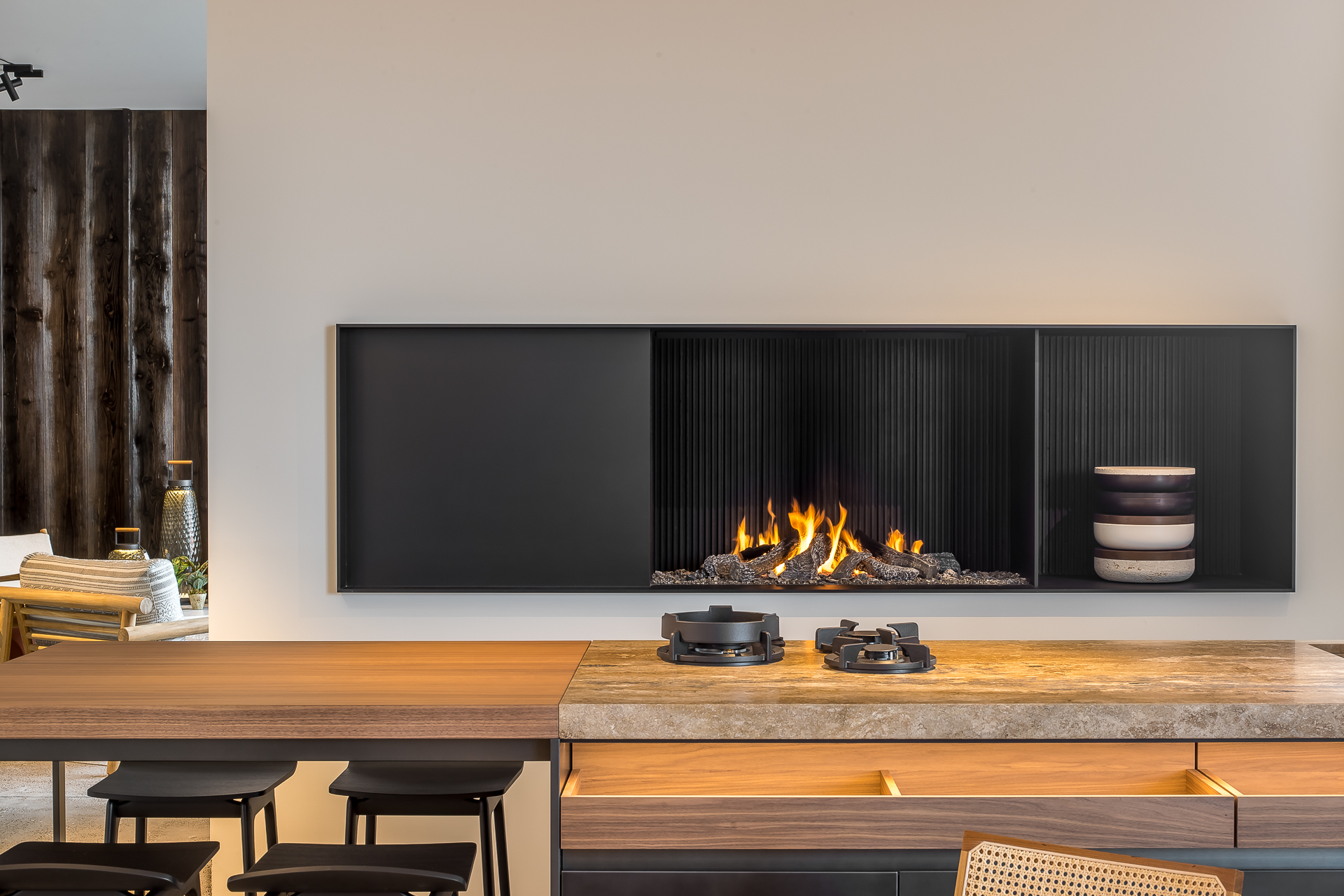
An open fireplace stands for warmth, calm and coming together around a fire. But does that image still fit a modern home that is built airtight, fitted with a ventilation system and has to meet strict Ecodesign standards?
Perhaps you have your doubts. About regulations. About sustainability. About efficiency. About the combination with a nearly zero-energy home. At the same time, you do not want to give up the feeling of architectural fire.
The short answer: yes, it is possible. An open wood fireplace, an open gas fire and a closed wood burning fireplace can all be perfectly integrated into a contemporary home. The difference lies in the technology and in what you expect from the flame picture. In this article we look clearly at the three options, so you can make a choice that matches both your home and your vision of fire.
In brief
- Yes, it is possible. An open wood fireplace, an open gas fire and a closed wood burning fireplace can all be integrated into a contemporary home.
- In an airtight nearly zero-energy home, an open fireplace works with an external air supply, a flue gas fan and electric dampers that stay closed when the fire is not burning.
- You choose an open fireplace for the direct experience of the fire and its architectural presence. If you are after maximum efficiency, a closed built-in wood burning fireplace is the better choice.
- Metalfire's open fireplaces are made fully bespoke, and an open outdoor fireplace can also be used as a barbecue.
- Since 2003 Metalfire has produced built-in gas fires, built-in wood burning fireplaces and bespoke open fireplaces in its own workshop in Belgium, to the same quality standard.
What do we mean by an open fireplace today?
When you talk about an open fireplace, two systems can fall under that term.
A traditional open wood fireplace works with open combustion and is fitted with a spark screen. The fire burns freely in the room, without a glass door. The combustion air is drawn in through an external air supply and the flue gases are discharged through the chimney. The draught in the flue co-determines how the fire burns. That creates the typical experience of open fire. At the same time, part of the heat disappears up the chimney, so the efficiency of an open fireplace is lower than that of a closed appliance.
A modern closed wood burning fireplace works differently. Here there is a glass door and a closed combustion system. The air supply is controlled and combustion is more efficient. That results in high efficiency, limited heat loss and a stable flame picture. Anyone looking today for a built-in wood burning fireplace for daily use in a contemporary interior usually ends up with a closed appliance.
Still hesitating between different types? Then a comparison between gas and wood fireplaces helps you see the differences clearly. The frequently asked questions about fireplaces also offer additional technical explanation.
Does an open fireplace fit an airtight modern home?
That is the heart of the question. Modern homes today are almost always built airtight. In nearly zero-energy homes the indoor climate is regulated by a type D balanced ventilation system (MVHR) with heat recovery. Such a system can create negative pressure in the living space, particularly in combination with extractor hoods or mechanical extraction.
An open fireplace that depends on natural draught therefore needs a specific technical design in that context. But it is certainly not impossible.
In a nearly zero-energy home, an open fireplace can be perfectly integrated by working with:
- An external air supply for the combustion air
- A mechanical flue gas outlet via a flue gas fan
- An electric flue damper, closed when the fireplace is not in use
- An electric air damper on the air supply, also closed at rest
When the fireplace is not burning, both dampers stay closed and the fireplace has no effect on the balanced ventilation. During use, the dampers open automatically and the flue gas fan ensures a stable draught. Feasibility is always assessed technically on a project-by-project basis, according to the ventilation system and the intended flue gas outlet.
A closed wood burning fireplace can be integrated more simply in most projects. Thanks to an external air supply, the combustion air is drawn directly from outside. Combined with a correctly designed flue gas outlet, the appliance works room-sealed and the ventilation system is left undisturbed.
If in doubt, you can always contact our technical department at support@metalfire.eu.
Efficiency and sustainability: how does it stand today?
If you look purely at efficiency, a closed wood burning fireplace is the most efficient solution. Controlled combustion and a precisely tuned air regulation deliver high efficiency and low heat loss. Appliances that meet the current Ecodesign standards also satisfy strict European requirements on emissions.
With an open wood fireplace the efficiency is lower, because part of the heat disappears up the chimney. That is a deliberate trade-off: you choose an open fireplace for the direct experience of the fire and its architectural presence, not as a main heat source.
If you use dry wood, wood heating can moreover be considered CO2-neutral. The CO2 released corresponds to what the tree absorbed during its growth. In that context a wood fireplace, closed or open, is a form of sustainable warmth, provided it is installed correctly and used responsibly.
For those who want to combine maximum efficiency with the look of an open fireplace, Metalfire also offers bespoke open gas fires. You can read more about that further in this article.
Aesthetics: keeping the open-fire feeling
For many people the choice is above all about experience.
The feeling of open fire can be preserved perfectly, both in a bespoke open fireplace and in a closed system with a large glass surface. In a closed fireplace, the minimalist frame keeps the flame picture fully visible, without visual clutter. In an open fireplace the glass disappears entirely and you are in direct contact with the fire.
An architectural fireplace can be designed as:
- A tunnel (double-sided) arrangement between two spaces
- A corner fireplace with a view from several angles
- A three-sided fireplace for a panoramic flame picture
- A clean front model integrated into the wall
- A fully bespoke fireplace with a 10 mm finishing frame
Thanks to bespoke work, the fire is aligned with the space and with the vision of the interior architect. This creates a fireplace that is not a separate element, but a considered integration into the interior as a whole.
When do you still choose a real open fireplace today?
A traditional open fireplace today mainly has a decorative and architectural function. Our open fireplaces are made fully bespoke, so they connect perfectly with the space, the architecture and the desired look of the project.
In outdoor spaces, or as an outdoor fireplace in a garden pavilion or outdoor room, open combustion comes fully into its own. Airtightness plays no role there and atmosphere takes centre stage. An open outdoor fireplace can moreover also be used as a barbecue, so it is not only an atmospheric element but also offers functional added value for those who like to cook outdoors.
Indoors, an open wood fireplace remains interesting in projects where experience and appearance take priority over maximum heating efficiency. Combined with a flue gas fan, electric flue damper and air damper, an open fireplace can also be realised in an airtight nearly zero-energy home. For those who do not want to miss the ritual of open fire, it remains a full-fledged choice, and often the most expressive one architecturally.
If you see fire primarily as experience, appearance and atmosphere, then a classic bespoke open fireplace is a fitting choice with clear architectural added value.
The role of an open gas fire
Alongside open wood fireplaces, Metalfire also produces bespoke open gas fires. These are gas-fired fireplaces with a minimalist design, intelligent safety systems and an open flame picture without glass.
An open gas fire combines the architectural character of an open fireplace with the comfort of gas: no laying of wood, no ash, a reliable flame picture with remote control. In an airtight home, an open gas fire is fitted with an external air supply, a mechanical flue gas outlet with backdraught protection and electrically controlled dampers on the air and flue gas flows. When the fireplace is not in use, these dampers stay closed and the balanced ventilation is not affected.
For projects with a closed gas fire from the Avenue range, integration is simpler. The closed combustion chamber is fully separated from the room, with a balanced flue system. All closed gas fires within the Avenue range are CE certified and meet the EN 613 standards.
Frequently asked questions about open fireplaces in modern homes
Yes. Do take regulations and local requirements into account. In new build, stricter requirements often apply than in renovation. Appliances must meet Ecodesign guidelines and emission standards. Ask about the rules in your municipality, or work with a specialist experienced in new build and renovation projects.
A traditional open wood fireplace has a lower efficiency than a closed appliance, because part of the heat disappears up the chimney. Anyone who wants to use the fireplace primarily as a heat source is better off with a closed built-in wood burning fireplace with controlled combustion. Anyone using the fireplace as an architectural and atmospheric element will find the most expressive solution in a bespoke open fireplace.
A closed wood burning fireplace has a glass door and an airtight system. Combustion is controlled, with higher efficiency and more stable performance. An open wood fireplace works without a glass door and with a spark screen, and offers a direct, sensory experience of the fire. Both options can be realised in a modern home, with a different technical design.
Yes. In a home with a type D balanced ventilation system, the air balance must not be affected by the fireplace. An open wood fireplace is therefore fitted with an external air supply and a mechanical flue gas outlet, so the air balance stays stable during operation. For comfort, the fireplace is equipped with electrically closable dampers on the air supply and flue gas outlet, which are closed when the fireplace is not in use. A closed wood burning fireplace is easier to integrate because the glass door separates combustion from the room. There too, an external air supply and a well-functioning flue are essential.
Yes. Open wood and gas fireplaces are a central part of the Metalfire range and are designed fully bespoke, together with the architect or interior designer. In addition, Metalfire also offers built-in gas fires and built-in wood burning fireplaces from its own range, which makes it possible to find a fitting solution for every project, from private new build to architectural renovation. Discover which fireplace your project deserves and plan a conversation with a Metalfire dealer or with our design advisers.
An open fireplace in a modern home calls for nuance, not compromise. A traditional open fireplace offers a direct, architectural experience of fire and can be realised in an airtight home provided you work with an external air supply, a flue gas fan and electric dampers. A closed built-in wood burning fireplace combines high efficiency with the look of visible fire and meets Ecodesign requirements. Both solutions bring fire into the home in a contemporary way.
Metalfire has designed and produced fireplaces in its own workshop in Belgium since 2003. As one of the few European manufacturers with fully in-house production and engineering, we combine Belgian craftsmanship with technical expertise. The entire range, built-in gas fires, built-in wood burning fireplaces and bespoke open wood and gas fireplaces, is created in the same production environment and to the same quality standard.
We work on a project basis with architects on interiors where fire, form and engineering come together. Every fireplace is the result of craftsmanship, precision and considered engineering.
About Metalfire
Since 2003 Metalfire has designed and produced bespoke fireplaces in its own workshop in Belgium. Our team of designers and engineers combines Belgian craftsmanship with technical expertise, innovation and craft.
We work on a project basis with architects on architectural interiors where fire is not an addition, but an integral part of the design. Thanks to technical guidance, detailing and bespoke solutions down to the millimetre, we support an integrated approach from design to delivery.
This page was compiled in collaboration with the Metalfire Design Team, made up of designers and engineers who develop gas and wood fireplaces every day for high-end architectural projects. Their experience in engineering, design and bespoke work guarantees the accuracy, quality and expertise on this page.
This page was created in collaboration with Technical engineer Manuel Debbaut